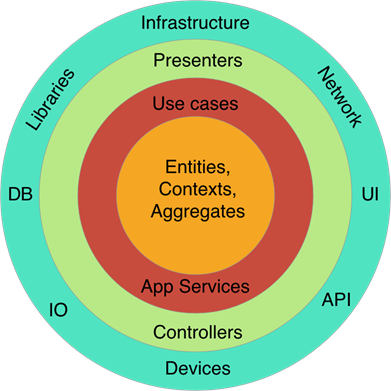
Book Library With DDD & Hexagonal Architecture
Click Here To See The Project Codebase
Book library with Onion (Hexagonal + DDD) Architecture, CQRS, Java Swing, Spring boot, Spring data, Spring security, H2, MYSQL, Openapi, Spring MVC, Thymeleaf & JDBC. Approaches such as password encryption, thread per request model and use of containerization with docker for the infrastructure has been realized.


A library manager built with hexagonal architecture principles and clean architecture domain-driven design (DDD), including patterns such as CQRS.
It now supports the original Swing user interface, Spring MVC and the Spring Boot REST API, with Spring Data JPA + H2 configured for the Spring run profile while retaining the same application/domain core. For Swing usage, Docker has been used to use MySQL as the infrastructure DB.
- for Spring, run directly SpringApiApplication.java
- for Swing
- run docker-compose.yaml
- then run SwingDesktopApplication.java
- accounts for testing: {alice, yasar1}, {bob, yasar2}
Architecture Overview
Hexagonal boundaries
- Inbound ports (driving adapters): Swing/Spring MVC/Spring REST views call application services through
application.ports.input.servicesinterfaces. This keeps UI logic interchangeable while preserving domain rules. - Outbound ports (driven adapters): Persistence, security, encryptors, and clock abstractions live under
application.ports.output. Infrastructure implements them with JDBC, JPA adapter repositories, password encryption, and system time utilities, enabling replacement without touching domain code.
Layer responsibilities
- Presentation
- Spring REST - OpenAPI + OpenAPI Security for use of user Bearer tokens
- Swing UI – Screens (Login, FavoriteBooks, FavoriteAuthors, UnreadBooks, WishlistNotification, etc.) gather user intent and delegate to application services without embedding business logic.
- Spring Mvc UI - Screens (Main, Search Books, Login, Profile, Favourites, etc.)
- Application layer – Coordinates use cases, permission checks, and transactions. Book use cases are split with CQRS (
BookCommandApplicationService+BookQueryApplicationService) and work alongsideUserApplicationServiceand other services to orchestrate repositories, mappers, and security ports while enforcing high-level workflows. - Domain layer – Aggregates like
Book,Author,User, andUserBookStateencapsulate business rules. Validation methods (validate()) protect invariants such as rating ranges, sensible publication years, release date ordering, and mandatory author names. Violations raise domain exceptions to keep rule enforcement close to the model. - Infrastructure layer – JDBC repositories implement persistence ports;
JdbcUnitOfWorkscopes transactional work;CypherPasswordEncryptorfulfills the password hashing/verification port;CurrentUserHolder(thread-local) implements the security context port;DatabaseConfigcentralizes connection lifecycle.
Security & Thread-local session handling
- Password hashing – The
PasswordEncryptoroutput port abstracts credential hashing/verification.CypherPasswordEncryptorencrypts and matches passwords before persistence or authentication, isolating crypto details from the UI and application layers. - Thread-local user context – Authentication populates a thread-local
CurrentUserholder. Application services read this context to authorize admin-only actions (create/update/delete books, orphan author cleanup) without passing session state through every method. UI classes only trigger login; they never cache credentials or user objects directly.- Since Spring runs on a per-request thread model, an adapter has been used which, underneath, uses SecurityContextHolder.
- Permission checks – Services guard mutations with role checks (reader vs. admin) and emit domain errors when callers lack rights, keeping enforcement centralized.
Domain business rules (DDD focus)
- Aggregate invariants –
Book.validate()constrains publication year ranges and required fields;UserBookState.validate()bounds ratings, restricts release dates to logical windows, and ensures status transitions remain consistent. - Consistency between aggregates – Book workflows ensure authors are created on demand and removed when no books reference them. User-book state updates keep comments, ratings, and statuses aligned with the owning
Useraggregate and the targetBook. - Explicit ubiquitous language – DTOs, entities, and services share domain vocabulary (wishlist, favorites, unread list, read status) to keep intent clear across layers.
- Error surfacing – Domain exceptions bubble up to the UI, allowing screens to show descriptive validation or permission messages without duplicating rules.
Key Features
- User authentication with thread-local session storage for downstream authorization.
- Role-based catalog administration for creating, updating, and deleting books with transactional author maintenance.
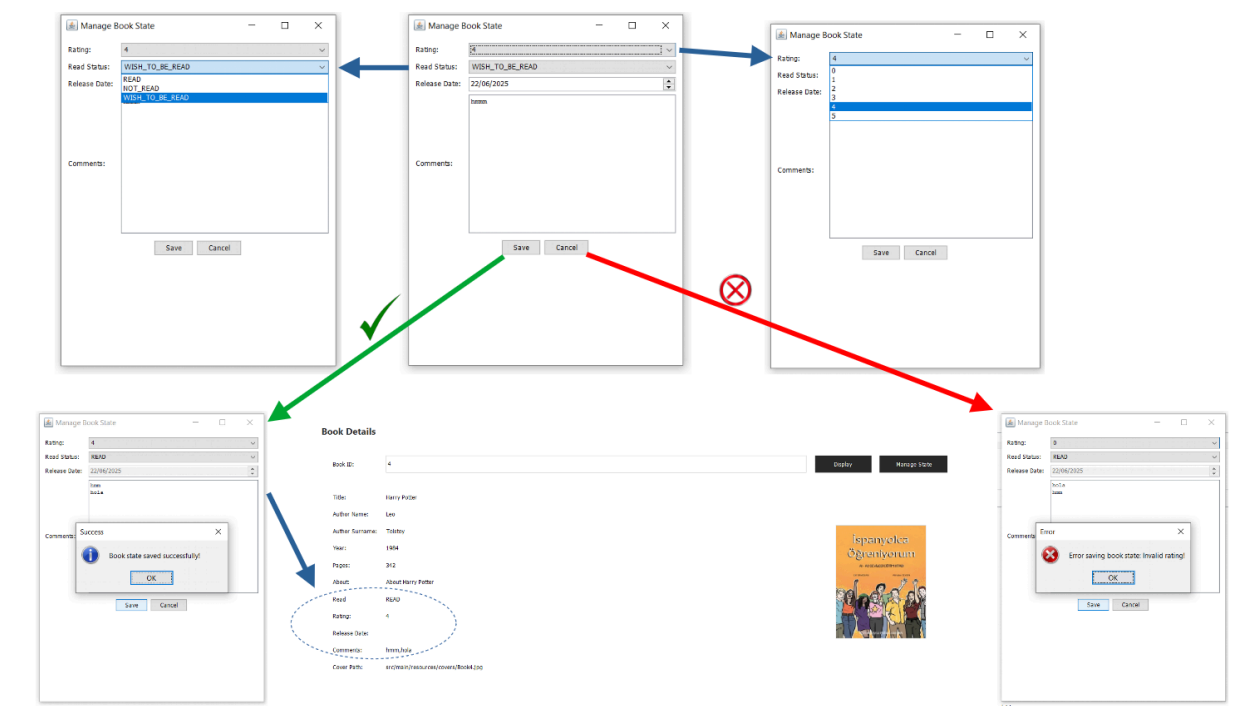
- Reading state tracking (read/unread/wishlist), ratings, comments, and optional release dates enforced by domain validation.
- Favorites and shortcuts surfaced through dedicated UI screens for quick navigation.
- Secure credential handling via the password encryptor port and infrastructure implementation.
- Transactional persistence coordinating repositories inside
JdbcUnitOfWorkto keep cross-aggregate updates atomic.
Project Structure
src/main/java/com/finalproject
├── presentation
│   ├── spring             # Spring API starter + REST controllers (inbound adapters)
│   └── swing              # Swing starter, views, and swing bootstrap wiring
├── application            # Use cases, ports, mappers, and application DTOs
├── domain                 # Entities, value objects, domain exceptions (core model)
└── infrastructure
    ├── configuration      # Spring security/openapi/bean configuration
    ├── persistence
    │   ├── jdbc           # JDBC adapters for Swing runtime
    │   └── jpa            # JPA adapters/entities/repositories for Spring runtime
    └── security           # Shared security helpers/context
Database & Infrastructure
- H2 + JPA setup – Spring runtime uses H2 (
jdbc:h2:mem:mylibrary) and Spring Data JPA. Schema and seed data are loaded automatically fromsrc/main/resources/db/h2/schema.sqlandsrc/main/resources/db/h2/data.sql. - Connection management –
DatabaseConfigis a lightweight singleton that loads the H2 driver, provides connections, and offers a shutdown helper. - Transaction boundary –
JdbcUnitOfWorkwraps JDBC operations, handling commit/rollback around supplied actions to keep application service workflows consistent.
Running the Application
- Swagger UI:
http://localhost:8080/swagger-ui/index.html - OpenAPI JSON:
http://localhost:8080/v3/api-docs - Use the Authorize button in Swagger with
Bearer <your_token>(token from/api/auth/login). - Only
/api/auth/loginis open; all other/api/**endpoints require JWT authentication.
Development Standards & Practices
- DDD building blocks – Entities and value objects enforce invariants through
validate()methods and domain-specific exception types. - Ports & adapters – Interfaces in
application.ports.inputandapplication.ports.outputdecouple use cases from transport, storage, and security implementations. - Explicit mapping – Mapper classes translate between DTOs and domain objects to keep UI and persistence concerns away from domain models.
- Manual dependency injection –
DependencyInjectorwires concrete infrastructure implementations into application services without a container, keeping wiring explicit and testable. - Security separation – Authentication state is held in thread-local context objects, and password handling goes through the
PasswordEncryptorabstraction to avoid leaking crypto details. - Error handling – User-facing flows catch
DomainExceptioninstances to surface validation or permission errors in the UI. - Java standards – Uses Java 17, conventional package naming, builder patterns for domain objects, and immutable IDs/value objects to minimize shared mutable state.
Resources
- Report – See
Swing-Report.pdffor the original project write-up. - Initial data – Cover images referenced in seed data live under
src/main/resources/covers/.
Technology Stack
| Category | Technology | Notes |
|---|---|---|
| Language | Java 17 | Records, sealed types, text blocks |
| Framework | Spring Boot 3.3.5 | Auto-configuration, embedded Tomcat |
| Web MVC | Spring MVC + Thymeleaf | Server-rendered pages, Thymeleaf Security extras |
| REST | Spring Web (Jackson) | JSON serialization/deserialization |
| API docs | springdoc-openapi 2.6 | Swagger UI, OpenAPI 3 spec |
| Security | Spring Security 6 | Stateless JWT chain (/api/**) + session chain (/mvc/**) |
| Auth tokens | JJWT 0.12.6 | HS256 signed JWTs; claims: userId, username, userType |
| ORM | Spring Data JPA / Hibernate | Spring runtime persistence |
| Raw JDBC | Custom JDBC adapters | Swing runtime persistence against MySQL |
| DB (Spring) | H2 in-memory | jdbc:h2:mem:mylibrary; schema + seed auto-applied |
| DB (Swing) | MySQL 8 (Docker) | Full relational schema, pre-seeded DML |
| Containers | Docker + docker-compose | MySQL service for Swing runtime |
| Desktop UI | Java Swing | NetBeans .form + .java pairs |
| Build | Maven 3 | Spring Boot Maven Plugin |
| Boilerplate | Lombok | @RequiredArgsConstructor, @Builder where applicable |
| Java versions | Java 17 | var, sealed interfaces, pattern matching |
Architecture Diagram
╔══════════════════════════════════════════════════════════════════╗
║                       PRESENTATION (UI)                          ║
║                                                                  ║
║  ┌──────────────┐  ┌──────────────────┐  ┌───────────────────┐  ║
║  │  Spring REST │  │   Spring MVC     │  │   Swing Desktop   │  ║
║  │  /api/**     │  │   /mvc/**        │  │   (JFrame/JPanel) │  ║
║  │  JWT + OpenAPI│  │  Thymeleaf+Sec  │  │  DependencyInjector│ ║
║  └──────┬───────┘  └────────┬─────────┘  └────────┬──────────┘  ║
╚═════════╪══════════════════╪═══════════════════════╪════════════╝
          │                  │                       │
          │   application.ports.input.services (interfaces only)
          ▼                  ▼                       ▼
╔══════════════════════════════════════════════════════════════════╗
║                     APPLICATION LAYER                            ║
║                                                                  ║
║   BookCommandApplicationService   BookQueryApplicationService   ║
║   UserApplicationService          AuthorApplicationService      ║
║   UserBookStateApplicationService                               ║
║                                                                  ║
║   application.ports.output.* (interfaces — never implemented here)║
╚═════════════╪══════════════════════════════════╪════════════════╝
              │ domain objects only               │ port calls
              ▼                                   ▼
╔══════════════════╗          ╔═══════════════════════════════════╗
║   DOMAIN LAYER   ║          ║       INFRASTRUCTURE LAYER        ║
║                  ║          ║                                   ║
║ Book             ║          ║  Spring runtime:                  ║
║ Author           ║          ║  ├─ JPA entity adapters           ║
║ User             ║          ║  ├─ Spring Data repositories      ║
║ UserBookState    ║          ║  ├─ JWT filter + BCrypt encoder   ║
║ 14 Value Objects ║          ║  └─ SecurityContextHolder adapter ║
║ 9 Exceptions     ║          ║                                   ║
║ validate()       ║          ║  Swing runtime:                   ║
╚══════════════════╝          ║  ├─ JDBC adapters (MySQL)         ║
                              ║  ├─ JdbcUnitOfWork                ║
                              ║  ├─ DatabaseConfig singleton      ║
                              ║  └─ ThreadLocal CurrentUser holder║
                              ╚═══════════════════════════════════╝
Dependency rule: every arrow points inward. Domain has zero external dependencies. Application depends only on Domain. Infrastructure and Presentation depend on Application and Domain — never the reverse.
Domain Model (DDD)
Entity hierarchy
BaseEntity<ID>          abstract — holds typed ID, declares validate()
├── Book                year [1000–currentYear], pages [0–10 000], cover, about
├── Author              name, surname, optional website URL
├── User                username, hashed password, UserType (READER | ADMIN)
└── Comment             content string with CommentId

AggregateRoot<ID>       extends BaseEntity — marks true consistency boundary
└── UserBookState       userId FK + bookId FK + Read enum + Rating + comments + ReleaseDate
UserBookState is the primary aggregate: reading status, ratings (0–5, minimum 1 when READ), comments, and optional wishlist release dates are all validated together in a single validate() call before any persistence operation.
Value Objects (14)
| Value Object | Type | Invariant enforced |
|---|---|---|
BookId |
int wrapper |
Typed identity, prevents accidental mixing with AuthorId |
AuthorId |
int wrapper |
Typed identity |
UserId |
int wrapper |
Typed identity |
CommentId |
int wrapper |
Typed identity |
UserBookStateId |
int wrapper |
Typed identity |
Year |
int wrapper |
Must be in [1000, LocalDate.now().getYear()] |
NumberOfPages |
int wrapper |
Must be in [0, 10 000] |
Cover |
String wrapper |
Path string; file-existence validation available (disabled for seed path compatibility) |
Rating |
int wrapper |
0–5; tightened to 1–5 when read == READ |
Read |
enum |
READ, NOT_READ, WISH_TO_BE_READ |
ReleaseDate |
LocalDate wrapper |
Must be present iff read == WISH_TO_BE_READ; must be null otherwise |
UserType |
enum |
READER, ADMIN |
Website |
String wrapper |
URL string for author portfolio |
BaseId<T> |
Generic abstract | Shared equals/hashCode on raw value for all typed IDs |
Domain Exception Hierarchy
DomainException (RuntimeException)
├── BookDomainException          — validation failures on Book
├── BookNotFoundException        — no book found for a given BookId
├── AuthorDomainException        — validation failures on Author
├── AuthorNotFoundException      — no author found for BookId/AuthorId
├── UserDomainException          — permission checks, role violations
├── UserNotFoundException        — no user found for credentials/id
├── UserBookStateDomainException — state/rating/releaseDate inconsistencies
└── UserBookStateNotFoundException — no state record found for user+book
All exceptions are unchecked. Application services catch nothing — they propagate up to the presentation layer, where Thymeleaf templates or REST exception handlers translate them into user messages or HTTP status codes.
CQRS in Practice
Why CQRS here
The book catalog has very different read vs. write profiles: reads are frequent, public, and paginated; writes are infrequent, admin-gated, and transactional. Separating the two services means:
- Read optimizations (projection, caching) never pollute the command model.
- The command path is easier to reason about: it's always admin-only, always wrapped in a
UnitOfWork, always followed byvalidate().
Command side — BookCommandApplicationService
| Method | Guard | Transaction | Side-effects |
|---|---|---|---|
createBook(CreateBookCommand) |
ADMIN |
UnitOfWork |
Creates Author on-demand if name+surname not found |
updateBook(UpdateBookCommand) |
ADMIN |
UnitOfWork |
Creates new Author on-demand; deletes old Author if it has no remaining books |
deleteBook(DeleteBookCommand) |
ADMIN |
UnitOfWork |
Deletes Author if it has no remaining books |
Query side — BookQueryApplicationService
| Method | Input | Output |
|---|---|---|
find(GetBookQuery) |
bookId: int |
FindBookResponse or BookNotFoundException |
findAll(SearchBooksQuery) |
title?: String, PageQuery(page, size) |
PageResult<FindBookResponse> |
PageResult<T> is a generic record:
(List<T> content, int page, int size, long totalElements, int totalPages, boolean first, boolean last)
with a map(Function<T,S>) utility for transforming content without rebuilding pagination metadata.
UserBookState operations
| Method | Permission | Description |
|---|---|---|
findUserBookOfCurrentUser(bookId) |
Any authenticated | Returns reading state for a book + defaults if no record exists |
findUserBookStatistics(bookId) |
Any authenticated | Aggregate: totalReads, averageRating, commentsCount |
findFavouriteBooksOfCurrentUser() |
Any authenticated | Books where rating >= 3 |
findNotReadBooksYetOfCurrentUser() |
Any authenticated | Books with no state record + records with NOT_READ combined |
findWishedBooksToReadThatWillBeDoneIn1WeekOfCurrentUser() |
ADMIN |
Wishlist entries with releaseDate within the next 7 days |
createUserBookForCurrentUser(request) |
Any authenticated | Calls UserBookState.validate() before save |
updateUserBookForCurrentUser(request) |
Owner only | Verifies userId == currentUser.id before update |
Dual Runtime Design
The project demonstrates that the same application/domain core can run against completely different infrastructure stacks:
| Concern | Swing (original) | Spring (extended) |
|---|---|---|
| Entry point | SwingDesktopApplication |
SpringApplication |
| DI container | Manual DependencyInjector class |
Spring IoC (@Bean, @Service) |
| Persistence | JDBC adapters — raw PreparedStatement/ResultSet |
JPA adapters — Spring Data JpaRepository |
| Database | MySQL 8 via Docker | H2 in-memory — zero external deps |
| Transaction | JdbcUnitOfWork (autoCommit=false, manual commit/rollback) |
Spring @Transactional (via JPA adapter) |
| User session | ThreadLocal CurrentUser holder |
SecurityContextHolder adapter |
| Auth | CypherPasswordEncryptor (BCrypt) |
Spring Security + BCrypt + JWT |
| UI | Java Swing (JFrame, JPanel, JTable, .form) |
Thymeleaf HTML templates + REST JSON |
Neither runtime knows about the other. The application and domain layers compile and run identically in both contexts — the only difference is which beans are wired in the DependencyInjector vs. Spring's context.
Security Architecture
JWT flow (REST API)
Client                    Spring Security                Application layer
  │                            │                               │
  │  POST /api/auth/login      │                               │
  │──────────────────────────► │                               │
  │                            │  UserApplicationService       │
  │                            │ ──────────────────────────── ►│
  │                            │  PasswordEncryptor.matches()  │
  │                            │ ◄──────────────────────────── │
  │                            │  JwtTokenProvider.generate()  │
  │◄────────── {token} ─────── │                               │
  │                            │                               │
  │  GET /api/books (Bearer)   │                               │
  │──────────────────────────► │                               │
  │                JwtAuthenticationFilter                      │
  │                validates token, sets SecurityContext        │
  │                            │  CurrentUserHolderAdapter     │
  │                            │  reads SecurityContextHolder  │
  │                            │ ──────────────────────────── ►│
  │                            │  isAdmin() / getId() checks   │
  │◄────────── response ─────── │ ◄──────────────────────────── │
Spring Security filter chain separation
Two independent filter chains prevent them from interfering:
@Order(1) ApiSecurityConfig   → securityMatcher("/api/**")  — stateless, JWT
@Order(2) MvcSecurityConfig   → securityMatcher("/mvc/**")  — stateful, form login
Port abstraction benefit
CurrentUser and PasswordEncryptor are output port interfaces in the application layer. This means:
- The application layer never imports
io.jsonwebtoken,BCryptPasswordEncoder, orSecurityContextHolder. - Swapping BCrypt for Argon2 or JWT for PASETO requires changing only one infrastructure class.
Swing Screens (12)
| Screen | Class | Access | Description |
|---|---|---|---|
| Login | Login.java |
Public | Username/password form; calls UserApplicationService; populates CurrentUser thread-local |
| Main Dashboard | MainPanel.java |
Authenticated | Navigation hub; shows user info and buttons to all sub-screens |
| Display Book | DisplayBook.java |
Authenticated | Full book detail: cover, metadata, reading state buttons |
| Book Operations | BookOperations.java |
Admin | Lists all books; entry to create/edit/delete flows |
| Book Creation | BookCreation.java |
Admin | Form to create a book + author; calls BookCommandApplicationService.createBook() |
| Book Edit | BookEdit.java |
Admin | Pre-filled edit form; calls updateBook() |
| Reading State Manager | BookStateManager.java |
Authenticated | Sets Read status, Rating, comments, optional releaseDate |
| Favourite Books | FavoriteBooks.java |
Authenticated | Books rated ≥ 3 via findFavouriteBooksOfCurrentUser() |
| Favourite Authors | FavoriteAuthors.java |
Authenticated | Authors of the user's favourite books |
| Unread Books | UnreadBooks.java |
Authenticated | Books with NOT_READ or no state record |
| Wishlist Notification | WishlistNotification.java |
Admin | Wishlist entries due within 7 days |
| Search Author | SearchAuthor.java |
Authenticated | Author search by name |
REST API Quick Reference
Authentication
POST /api/auth/login
Content-Type: application/json

{ "username": "alice", "password": "yasar1" }
Response:
{ "id": 1, "username": "admin", "userType": "ADMIN", "token": "<JWT>" }
All other endpoints require Authorization: Bearer <JWT>.
Book endpoints
# Paginated catalogue
GET /api/books?page=0&size=10

# Title search
GET /api/books?title=refactoring&page=0&size=5

# Single book
GET /api/books/{id}

# Create (ADMIN, 201 Created)
POST /api/books
{
  "authorName": "Martin", "authorSurname": "Fowler",
  "title": "Refactoring", "year": 2018,
  "numberOfPages": 448, "about": "Improving existing code",
  "coverPath": "src/main/resources/covers/Book1.jpg"
}

# Update (ADMIN, 200 OK)
PUT /api/books/{id}          { same fields }

# Delete (ADMIN, 204 No Content)
DELETE /api/books/{id}
Reading state endpoints
# Get my state for a book
GET /api/user-book-states?bookId={id}

# Create my state
POST /api/user-book-states
{
  "bookId": 1,
  "read": "READ",
  "rating": 5,
  "comments": ["Highly recommended"]
}

# Wishlist entry (WISH_TO_BE_READ requires releaseDate)
POST /api/user-book-states
{
  "bookId": 2,
  "read": "WISH_TO_BE_READ",
  "rating": 0,
  "releaseDate": "2025-03-01"
}

# Update
PUT /api/user-book-states/{id}   { same fields }
Default test credentials: admin / 123 (ADMIN) · reader / 123 (READER)
Design Patterns Reference
| Pattern | Implementation | Location |
|---|---|---|
| Hexagonal / Ports & Adapters | Input/output port interfaces; all adapters implement ports, never extend domain | application.ports.* + all infrastructure.* |
| Domain-Driven Design | Entities, aggregate roots, value objects, domain exceptions, ubiquitous language, validate() |
domain.* |
| CQRS | Separate command and query application service interfaces and implementations | BookCommandApplicationService* / BookQueryApplicationService* |
| Repository | Port interface + JDBC adapter + JPA adapter per aggregate | ports.output.repository.* |
| Unit of Work | UnitOfWork @FunctionalInterface port; JdbcUnitOfWork wraps commit/rollback |
UnitOfWork.java, JdbcUnitOfWork.java |
| Builder | Every aggregate and entity exposes a nested Builder with fluent setters |
Book.Builder, Author.Builder, User.Builder, UserBookState.Builder |
| Factory Method | Book.Builder.newBuilder(), User.Builder.newBuilder() |
Domain entity builders |
| Adapter | JPA ↔ domain mappers; JDBC adapters; PasswordEncoderImpl; CurrentUserHolderAdapter |
infrastructure.* |
| Strategy | JDBC vs JPA persistence strategies injected behind the same port interface | Dual runtime — same port, two implementations |
| Template Method | BaseEntity.validate() declared abstract; each entity provides its own rules |
BaseEntity, Book, UserBookState |
| Facade | Application services present a simple interface over domain + UnitOfWork + multiple repos | All *ApplicationServiceImpl classes |
| Null Object | findUserBookStatistics returns a zero-value FindUserBookStatisticsResponse instead of null |
UserBookStateApplicationServiceImpl |
| Singleton | DatabaseConfig manages one shared JDBC connection lifecycle for Swing runtime |
DatabaseConfig.java |
| Dependency Injection (manual) | DependencyInjector wires concrete classes without a container — makes dependencies explicit |
presentation.swing.dependency |
Quick Start
# Clone
git clone <repo-url>
cd book-library-jdbc-swing

# Run Spring (REST + MVC, H2 auto-starts)
mvn spring-boot:run

# Then open:
open http://localhost:8080/mvc/books           # Web UI
open http://localhost:8080/swagger-ui/index.html  # API docs
| URL | Description |
|---|---|
/mvc/books |
Thymeleaf home — hero section + trending carousel |
/mvc/books/{id} |
Book detail — stats, user rating & comments |
/mvc/login |
Form login |
/swagger-ui/index.html |
Interactive API explorer |
/v3/api-docs |
Raw OpenAPI 3 JSON |
| User | Password | Role |
|---|---|---|
admin |
123 |
ADMIN — full CRUD |
reader |
123 |
READER — reading states only |